
Bank deposits, withdrawals, and virtual account funding.
Private sandbox now open
Stablecoin rails for markets that actually move USD, BRL, MXN and more.
Launch compliant onramps, offramps, virtual accounts, quotes, and local payouts across ACH, PIX, SPEI, SEPA, FPS, and USDC settlement through one network that routes orders across eligible providers without exposing institutional partner credentials to client apps.
Every tenant is isolated. Every end customer completes partner KYC.
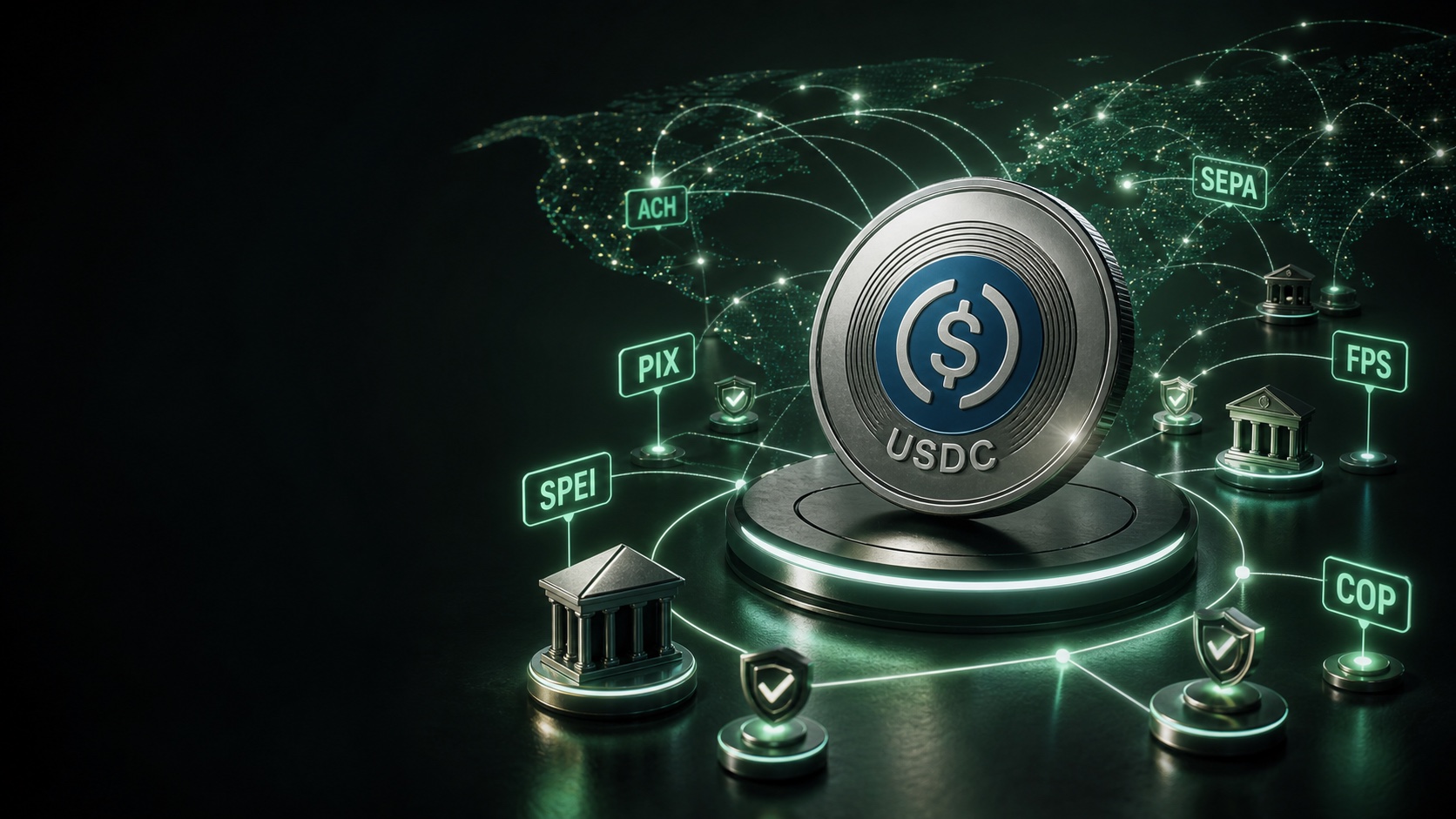
USA ACH / Wire
BRA PIX / BRL
MEX SPEI / MXN
USDC Base settlement
Supported corridors
Start where customers already bank, then settle into USDC when the product needs programmable dollars.
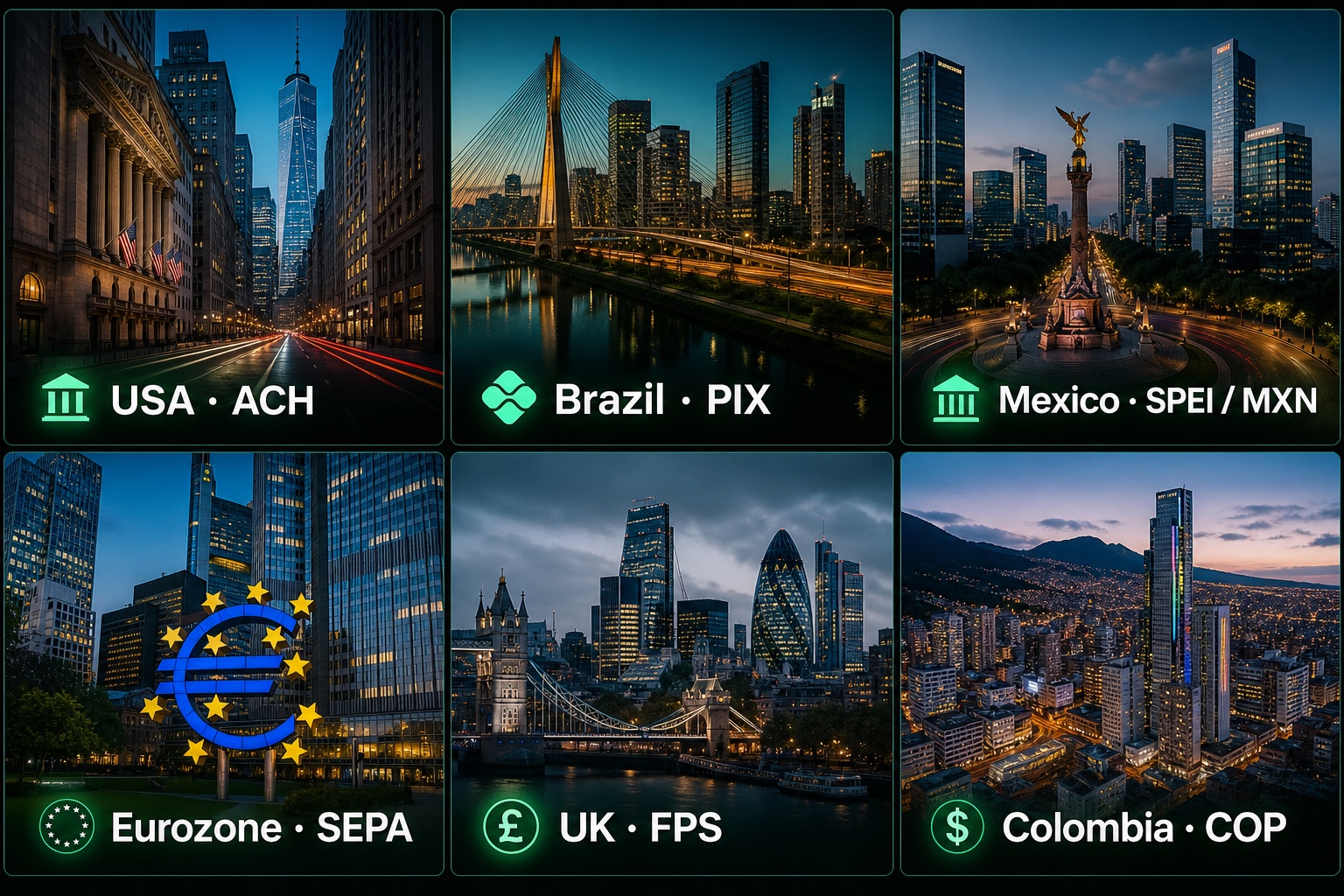
Instant local bank rails for Brazilian real corridors.
Mexican peso movement through the local electronic transfer rail.
Euro account-to-account routes for SEPA markets.
UK bank transfers through FPS-enabled payout paths.
Colombian peso coverage tracked as a controlled rollout.
Clear pricing before movement
Show every fee before funds move.
Quote first, move second. Partner costs, the Avra base fee, and your own markup stay visible before the transfer is created.
Partner cost
Pass-through
Avra base fee
0.30%
Your markup
Configurable
No enterprise sandbox tax and no $5k/month minimum just to validate demand. Test rails, KYC gates, quotes, transfer signing, and fee rules before scaling volume.
Quote-first UX
Let users see the rate, rail, fees, and payout before they commit.
A web demo of the Monet bank-transfer quote flow: enter USD, choose a local payout route, and watch the received amount update with animated numbers.
From
 USD
USD
USD
To
Paying with
USDC wallet
Arrives
Usually within 30 minutes
Total fees
$12.50
Exchange cost included in the rate
Provider network
Avra aggregates eligible providers and routes for the best executable quote.
Each quote checks available institutional LPs, partner banks, and regional rail providers, then selects the strongest route after pricing, customer status, speed, limits, compliance rules, and settlement preference.
Avra normalizes rates, provider costs, network fees, and route constraints behind one quote response.
KYC state, destination country, rail support, transfer size, and tenant permissions are checked before signing.
The quote ranks rate, speed, provider reliability, Avra fee, tenant markup, and expected received amount together.
If a provider is unavailable, Avra can route to the next eligible path before an idempotent transfer is created.
The stack
Infrastructure your product can build on, without rebuilding the regulated layer.
01 / IDENTITY

Customer onboarding
Create individual or business customers and launch hosted KYC or KYB review. Money movement stays locked until approval is active.
Built in sandbox02 / ACCOUNTS

Virtual accounts
Issue reusable fiat deposit details for approved customers and define where converted funds settle.
Partner-bank ready03 / ORCHESTRATION

Quotes and transfers
Lock route, partner costs, Avra fees, and tenant markup in a quote before a signed, idempotent transfer is created.
Quote engine ready04 / ROUTING

Partner-aware routing
Keep one Avra contract while institutional LPs, partner banks, and regional rail partners evolve behind the server boundary.
Partner network expandingA controlled flow of funds
Your users see your product. Partner banks and LPs see the correctly identified customer and full transaction context.
Create a customer
Your tenant sends only the required customer profile.
POST /v1/customers
Complete KYC
The hosted flow records consent and verifies the end customer.
POST /kyc-sessions
Price the route
Avra returns partner, Avra, tenant, and network fees explicitly.
POST /v1/quotes
Move the funds
A signed request executes once and creates a durable audit trail.
POST /v1/transfers
Designed for the real trust boundary
One partner relationship does not mean one shared identity.
Avra holds institutional partner credentials server-side. Each developer gets a scoped API key, each request is signed, and every customer remains a distinct KYC record at the underlying partner.
AUTH
HMAC SHA-256 request signing
Timestamp and nonce replay protection
SCOPE
Tenant and permission isolation
Per-key scopes with optional IP allowlists
STATE
Idempotent write operations
Safe retries across client and partner timeouts
AUDIT
Request, fee, and ledger records
Traceable operations without leaking partner credentials
Developer-side controls
Sandbox is open. Production money movement is KYB-gated.
Developers are not the end users receiving virtual accounts, but they do control API keys and transfer initiation. Avra reviews the tenant before live access and watches for obvious abuse.
Companies complete KYB and control-person checks. Individual builders complete KYC before live access.
Quotes lock route and fees, transfers are idempotent, and destination context is recorded for review.
Risk tiers, hourly limits, IP allowlists, and scoped keys reduce blast radius for abusive tenants.
Request IDs, nonces, idempotency keys, fees, and ledger entries stay tied to the tenant and customer.
Avra token
Network incentives for builders who create real volume.
The token design is built around product usage, not paid hype: no marketing fund, a 5% team allocation, and developer rewards tied to volume milestones in the API network.
Avra purchased half of the supply.
Half of the purchased allocation was permanently burned.
The remaining purchased allocation is reserved in a smart contract for developer volume milestones.
Avra plans to direct half of API fees to recurring token purchases under a published policy.
Token mechanics are subject to final legal review and launch docs. Developer rewards are designed as network participation incentives, not a promise of profit or passive yield.
Developer first
Start in the mock sandbox. Switch live partners later.
The public contract stays stable while live partner access remains gated by commercial and compliance approval.
Node.js
Signed request
const response = await avra.customers.create({
  external_id: "user_1042",
  type: "individual",
  full_name: "Avery Morgan",
  email: "avery@example.com",
  country_code: "US"
})

console.log(response.customer.id)
Developer console
Sandbox workspace
Signed in
Across ACH, PIX, SPEI, SEPA, FPS, COP, and USDC routes.
0.30% base fee accrued on sandbox transfer volume.
Tenant markup collected above Avra and partner costs.
91.8% active KYC rate, 73 customers pending review.
Rail volume
Where funds are moving
Set your markup on top of Avra.
Avra30 bps
Your markup20 bps
Total platform fee50 bps
Google authenticates the developer. API keys authenticate servers.
Browser sessions never receive partner credentials or HMAC secrets. Tenant provisioning, fee limits, and production access remain server-controlled.
Loading…